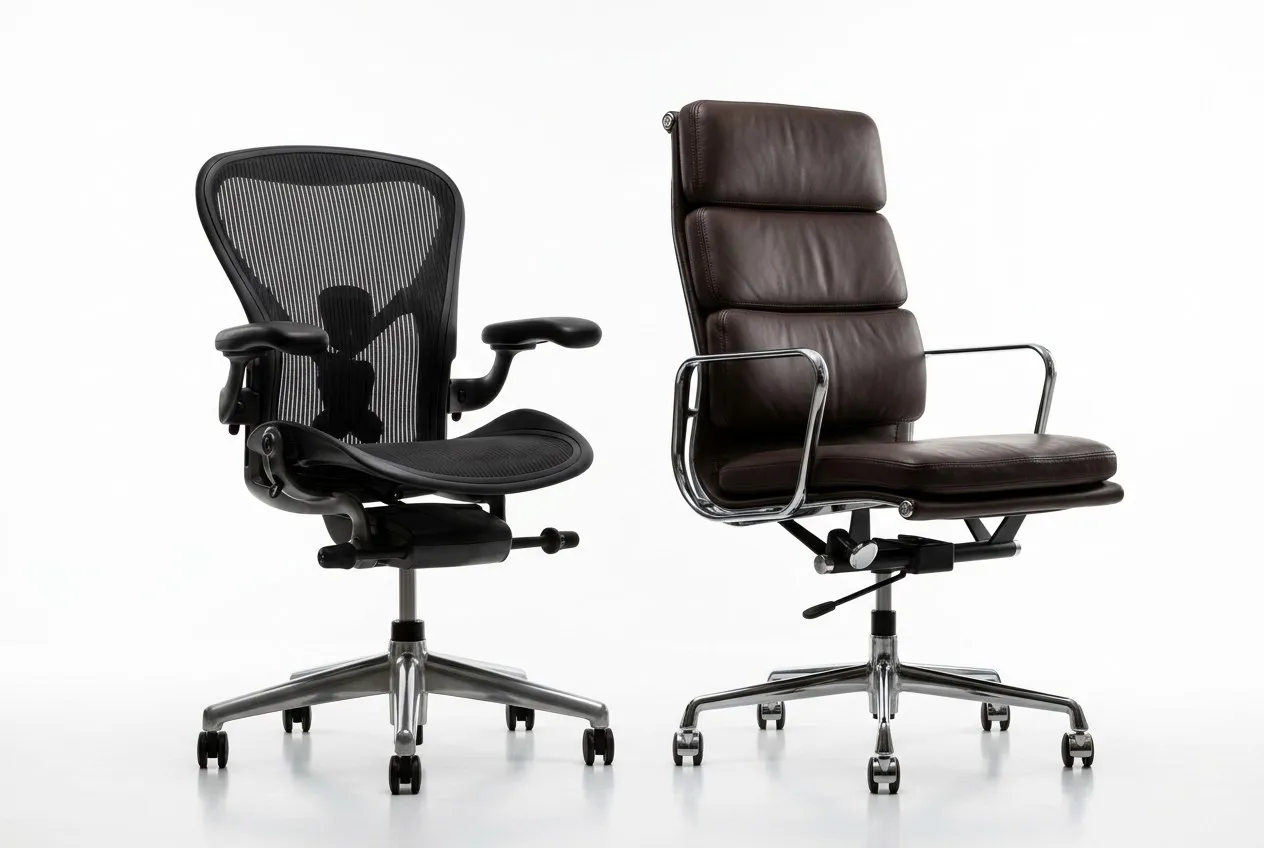
One of the most common questions we receive from office furniture distributors and corporate procurement managers is: should I order mesh or leather office chairs? The honest answer is that neither is universally better — the right choice depends on the environment, the end users, and the priorities of the organization.
This guide breaks down the comparison so you can make the right recommendation for each client situation.
Mesh Office Chairs
Mesh chairs use a woven fabric stretched over a frame for the backrest — and sometimes the seat — instead of foam padding.
Advantages
Breathability: This is mesh’s defining advantage. The open weave allows air to circulate through the back panel, preventing heat and sweat buildup during long sitting sessions. In warm climates or non-air-conditioned offices, this can be a significant comfort differentiator.
Weight: Mesh chairs are typically lighter than leather equivalents, making them easier to move and reposition throughout the workday.
Modern aesthetic: Contemporary offices tend to favor the clean, professional look of mesh. It signals ergonomics-forward workplace design.
Lower price point: For equivalent ergonomic features, mesh chairs are generally less expensive than leather chairs — an important consideration for large-volume corporate procurement.
Disadvantages
Durability concerns: Mesh can stretch, sag, or develop small tears over time, particularly under heavy daily use. High-quality mesh chairs use commercial-grade weaves; lower-end products may show wear within 2–3 years.
Limited cushioning: Some users prefer the plush feel of foam padding. Mesh can feel firmer, which some find uncomfortable for very long sessions.
Perception issues: In some industries (finance, law, executive settings), mesh chairs may be perceived as less premium than leather.
Leather Office Chairs
Leather chairs use genuine leather, PU (polyurethane) leather, or bonded leather over foam padding for both the seat and backrest.
Advantages
Executive presence: Leather chairs, particularly high-back executive models, convey authority and status. They are the standard for C-suite offices, law firms, financial institutions, and boardrooms.
Cushion comfort: High-density foam beneath leather provides a cushioned, plush feel that some users strongly prefer over the spring-like feel of mesh.
Easy to clean: Smooth leather surfaces wipe clean quickly — a practical advantage for healthcare settings, food industry offices, or any environment where spills are a concern.
Durability of genuine leather: High-quality genuine leather chairs can last a decade or more with proper care.
Disadvantages
Heat retention: Leather doesn’t breathe. Extended sitting can cause discomfort from heat and perspiration buildup, particularly in warm climates or during summer months.
Higher price: Genuine leather chairs are considerably more expensive than mesh equivalents with similar ergonomic features.
Maintenance requirements: Leather requires periodic conditioning to prevent cracking and fading. PU leather eventually peels and is harder to repair.
Decision Framework for B2B Buyers
| Factor | Choose Mesh | Choose Leather |
|---|---|---|
| Climate | Warm / tropical | Cool / air-conditioned |
| Hours of use | 6–10 hours/day | 4–6 hours/day |
| Office aesthetic | Open plan, tech, startup | Executive, finance, law |
| Budget | Standard to mid-range | Mid-range to premium |
| Maintenance preference | Low | Medium |
| User age group | Mixed / younger teams | Executive / senior level |
What CXstyle Offers
CXstyle manufactures both mesh and leather office chair lines, giving distributors access to a complete range for different client segments. Our mesh chairs use commercial-grade woven mesh panels with multiple tension options; our leather executive chairs are available in genuine leather, PU leather, and bonded leather configurations.
Both lines support OEM customization including frame color, fabric specifications, armrest style, and private-label branding.
Request our product catalog to see the full range and wholesale pricing.